
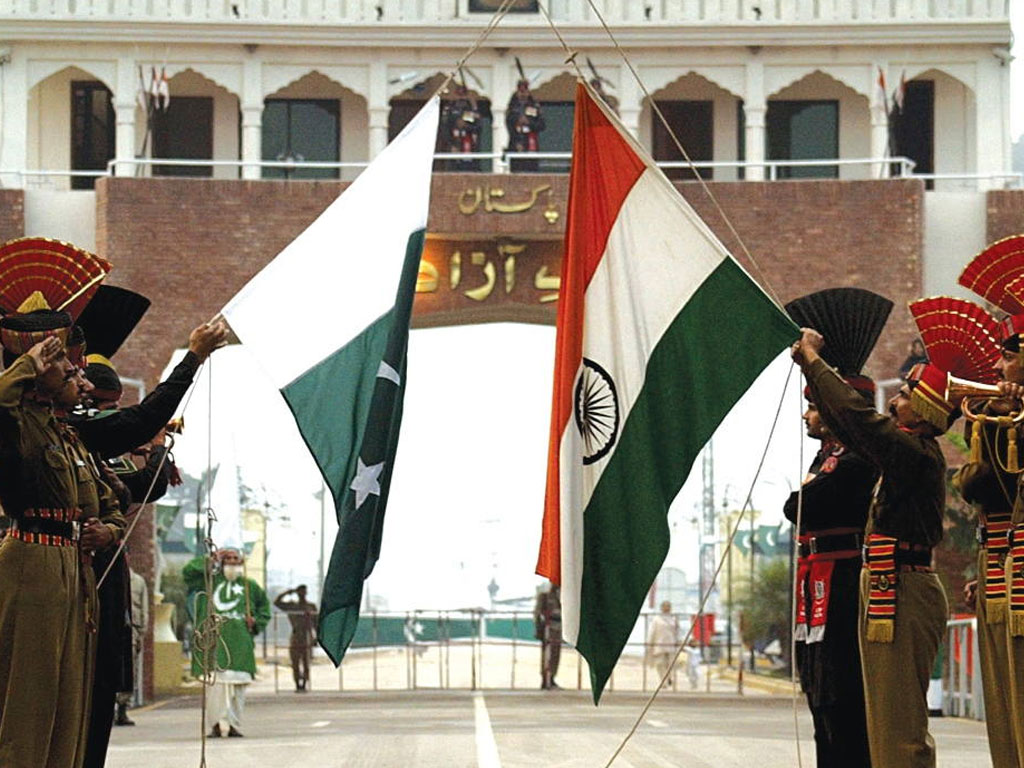
In the wake of New Delhi's abominable repressive campaign in Occupied Kashmir there is the grim possibility of a nuclear war between Pakistan and India, and Pakistan won't like the world to be caught unaware. Early this month, Prime Minister Imran Khan warned that "not only the subcontinent but the entire world will suffer in case of a war between the two countries that have nuclear weapons. I'm telling you [the international community] that if you keep silent on aggression and tyranny it will affect the world". That warning has now been repeated by Foreign Minister Shah Mehmood Qureshi. Speaking to journalists on the sidelines of the UN Human Rights Council session in Geneva on Wednesday, he was more explicit on how it would come about. "If there is a false-flag operation, which we fear, and they [India] use it as a pretext and carry out some misadventure against Pakistan, we will respond, and we will respond with force ... and you never know, we could be into an accidental war". A conventional war between two nuclear powers has every possibility of turning into a nuclear war, and it is that very fear which has acted as a deterrence against an armed conflict between them. India believes, rightly, that its false-flag campaigns, waged in the name of actions against terrorists, against Pakistan sit well with the international community. Now when it wants to divert the world attention away from its brutal campaign in Occupied Kashmir such a move is in order. Last week, it raised the ante of infiltration through the Line of Control and now it is talking of intrusions through Rann of Kutch. But Pakistan would like the world to know that any such misadventure would have apocalyptic consequences. This would precipitate a wider conflict between the two nuclear powers.
Such an 'accidental' war may or may not take place, but what is more likely and circumstantially unavoidable is the post-curfew imbroglio. Life won't return to normalcy; it would be the beginning of a far-more committed intifada in Occupied Kashmir. One would be only naïve to think that many weeks long security lockdown and communication blackout must have weakened the Kashmiris' will to fight and get back their freedom. Their illegal detention, draconian clampdown and excessive use of pallet guns haven't broken their spirit; in fact, these repressive antics have generated political unity, turned India into a common enemy of all, including the Muftis and the Abdullahs, and full freedom instead of revival of the state's special status as their final goal. There would be bloodshed on the streets of Srinagar and all across the Occupied Valley, provoking calls for jihad against practitioners of Hindutva. If all is well and life is returning to normality in Occupied Kashmir, as claimed by India, then why not allow visits of international media and human rights observers. Pakistan would like UN rights chief Michelle Bachelet to visit the troubled region and see for herself if Modi is truthful.
Accepted, apparent indifference of international community to the plight of Kashmiris is embedded in its members' political alignments and economic interests. It is also accepted that to some the Kashmiris' struggle against Indian occupation has a religious connotation and therefore they should remain indifferent. But to this the situation in Occupied Kashmir there are two peculiarities, which outweigh the rational to remain indifferent. One, it is a case of human rights violations, and therefore an issue of concern to decent people all over the world. Isn't it a fact that India's Nobel Laureate Amartya Sen slammed revocation of Article 370, saying it only emphasised majority rule "as opposed to it sustaining the rights of all human beings". Two, the issue has a nuclear dimension. Both Pakistan and India are nuclear-weapon states. Simply stated, both are ready for nuclear clash, to which the trigger can be the India's false-flag war doctrine.